The Overall Results Framework (ORF) was at the heart of the latest ENFP Network Meeting, held on 24 June 2026 and dedicated to the upcoming Periodic Reporting cycle.
The meeting opened with a brief exchange on the main outcomes of the 11th General Assembly of the 2003 Convention, particularly the recent revisions to the Operational Directives and the transition to a new global Periodic Reporting system. This was followed by an open Question Time, during which focal points had the opportunity to discuss practical questions directly with members of the UNESCO Secretariat while also learning about the other focal points' experience in reporting. Participants exchanged on a wide range of topics, including the revised reporting forms, reporting timelines, baseline indicators, and the practical implementation of the new reporting system in different national contexts.
Building on these discussions, the final session of the meeting focused on the Overall Results Framework (ORF). Led by Jorijn Neyrinck (Facilitator and member of the ENFP Steering Committee), the presentation provided an introduction to the ORF, its objectives, and its practical application within the old and new reporting system.
More than a reporting tool
One of the presentation's key messages was that the ORF should not simply be understood as another reporting requirement.
Developed as part of UNESCO's broader Results-Based Management approach, the ORF provides a common framework for assessing how the Convention is being implemented and what changes safeguarding efforts are producing over time. Rather than asking only "What activities have been carried out?", it encourages States Parties to ask a more fundamental question: "What difference are these activities making?"
This shift from activities to outcomes is at the heart of the framework. Instead of measuring success by the number of workshops organised, inventories completed or awareness-raising events held, the ORF focuses on whether these actions contribute to stronger safeguarding systems, greater community participation, improved policies and a more enabling environment for living heritage.
Where does the ORF come from?
The Overall Results Framework did not emerge solely from the needs of the Periodic Reporting process. It is the result of several years of reflection within the framework of the 2003 Convention and forms part of a broader shift across the United Nations system towards results-based management.
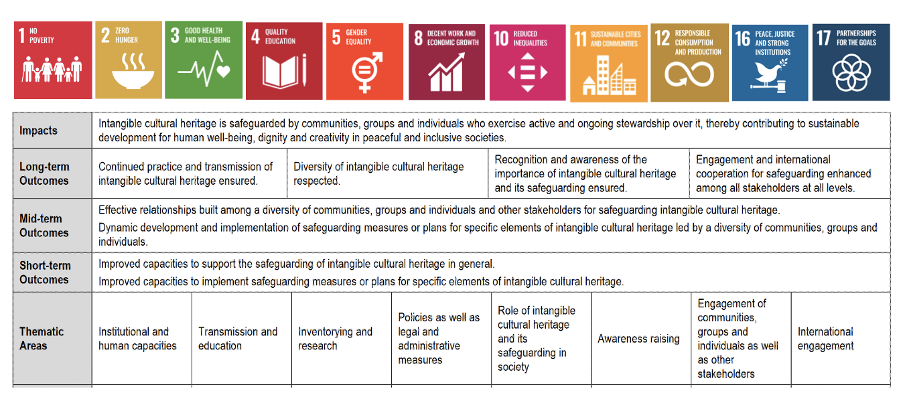
Following the development and adoption of the 2030 Agenda for Sustainable Development and the Sustainable Development Goals (SDGs), UNESCO increasingly sought to strengthen its ability to demonstrate the impact of its programmes and normative instruments. Rather than focusing exclusively on activities and outputs, greater emphasis has been placed on understanding how these contribute to long-term social, cultural, environmental and economic outcomes and sustainable development.
Within the framework of the 2003 Convention, this led to the establishment of an open-ended intergovernmental working group, tasked with developing a common framework for monitoring the implementation of the Convention. Working over several years, the process brought together experts to identify a set of expected results and indicators capable of reflecting the many dimensions of safeguarding living heritage. The resulting Overall Results Framework, adopted by the General Assembly in 2018, now provides a shared reference.
A framework for reflection and continuous improvement
The presentation also underlined that the true value of the ORF lies in the reflection it encourages before, during and after the reporting process.
Its purpose is to help States Parties better understand their own safeguarding mechanisms, identify strengths and weaknesses, monitor progress over time and support evidence-based decision-making. Rather than functioning as an external evaluation, the framework encourages countries to reflect on their own experiences and to use the reporting process as an opportunity to improve safeguarding policies and practices.
This philosophy is also reflected in the revised Periodic Reporting process, which places greater emphasis on self-assessment, national dialogue and long-term monitoring.
Understanding the different dimensions of safeguarding
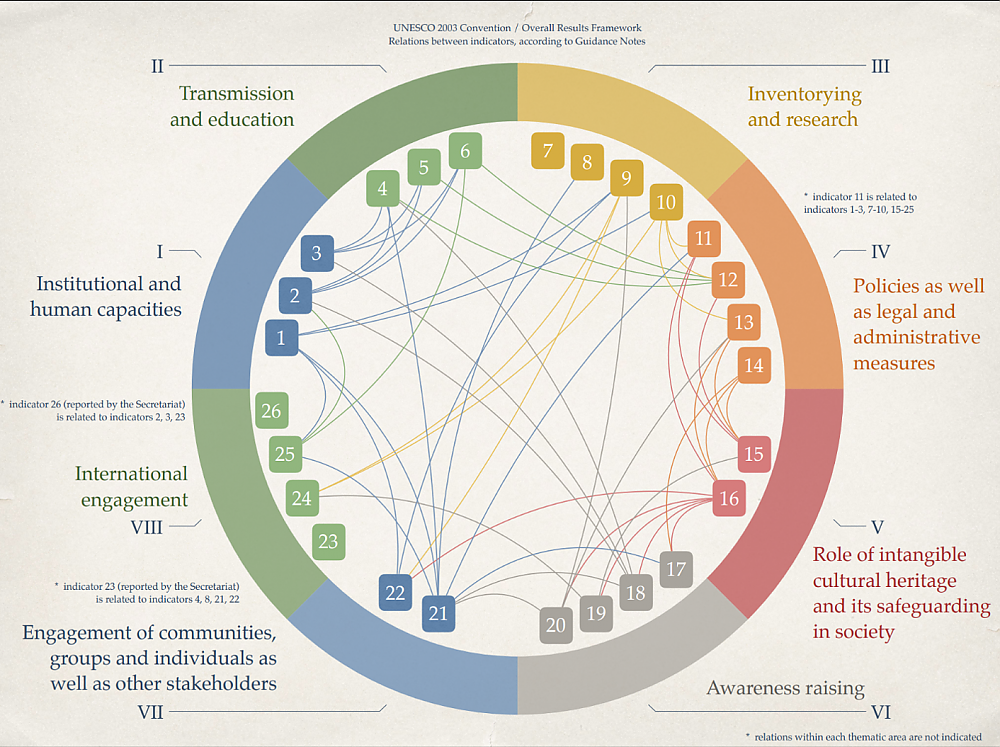
Participants were introduced to the structure of the ORF and its different expected outcomes, results and indicators, which together provide a comprehensive picture of the implementation of the Convention.
These indicators cover a broad range of themes, including:
Rather than treating these areas independently, the framework illustrates how they contribute collectively to the overall objectives of the Convention and reinforce one another.
Why the ORF matters now
With the transition to a single global Periodic Reporting cycle, understanding the ORF in its broader endeavour for long term change and impact, and sustainable development is key for focal points.
The revised reporting forms remain fully aligned with the framework, using the ORF as the backbone of the reporting exercise. Beyond supporting the preparation of national reports, it offers focal points an opportunity to take a step back, engage with communities and institutions, and reflect on the longer-term impact of safeguarding efforts.
The discussion that followed the presentation confirmed the strong interest among participants in continuing to explore the framework. Questions focused on the interpretation of indicators, the establishment of baselines and the practical application of the ORF in different national contexts, demonstrating the value of continued peer exchange throughout the reporting process.
Learn more
For colleagues wishing to deepen their understanding of the Overall Results Framework, UNESCO has developed a dedicated online course available through the UNESCO Learning Platform.
The self-learning course provides a comprehensive introduction to the principles of the ORF, explains how the framework relates to the implementation of the 2003 Convention and the Periodic Reporting process, and offers practical guidance for applying the indicators in national contexts.
The ENFP Steering Committee encourages all focal points, facilitators and members of national reporting teams to explore these resources while they prepare for the upcoming reporting cycle.